
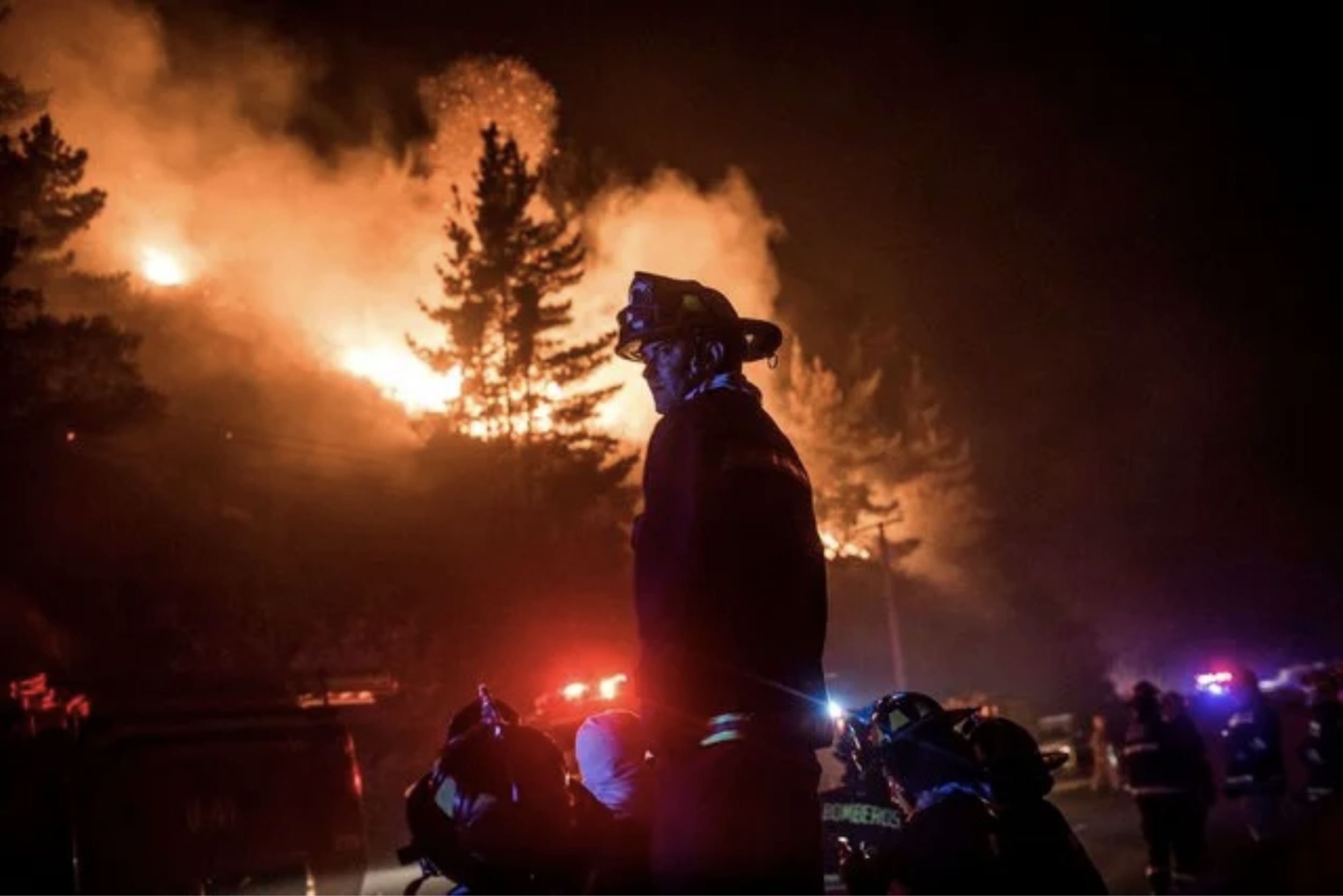
Empowering those who protect us
Empowering those who protect us
Time is of the essence when you’re faced with an emergency or natural disaster like wildfires.
Yet despite advances in communications and information technology, significant interoperability gaps remain between first responder organizations, jurisdictions, and emergency management systems.
These challenges become even more pronounced when career and volunteer responders, mutual-aid resources, and self-organizing emergency response teams converge from local, regional, tribal, state, federal, and international organizations—including humanitarian organizations such as the Red Cross.
What's missing is a common, adaptable technology framework that enables these diverse participants to securely access, exchange, and interact with mission-critical information—working together as a unified Team of Teams.
Without this level of connectivity and shared situational awareness, coordination becomes more difficult, critical decisions can be delayed, and the risks to responders, lives, property, and communities can increase unnecessarily.
This critically impairs the aid and coordination efforts undertaken during emergencies and natural disasters — putting lives, homes and communities in additional and unnecessary danger.
This is where we come in.
FireCast — Connecting First Responders. Strengthening Emergency Response.
One Platform. Multiple Agencies. A Common Operating Picture.
Emergency response operations are increasingly complex, requiring firefighters, law enforcement, emergency medical personnel, and disaster response organizations to coordinate across jurisdictions, communications networks, and traditionally disconnected information systems.
We've developed FireCast®, a scalable, multi-tier technology platform designed to bridge these operational gaps, strengthen situational awareness, and improve coordination among first responders operating in demanding and often dangerous environments.
Our mission is simple: Help first responders work together as one coordinated force, regardless of their organization, location, or communications infrastructure.
Breaking Down Barriers Between Emergency Response Organizations
During major emergencies, responding personnel often arrive from multiple agencies, jurisdictions, and specialized organizations, each bringing their own communications equipment, operational procedures, and information systems.
Unfortunately, these systems don't always communicate effectively with one another, creating information gaps that can complicate resource coordination and operational decision-making.
The FireCast Platform is designed to help bridge these gaps.
Rather than replacing established Computer-Aided Dispatch (CAD) systems or Mobile Data Terminals/Computers (MDTs/MDCs), FireCast complements and extends these investments through its FireCast Gateways, FireCast Web Services, and FireCast Cloud infrastructure.
Together, these components establish an adaptable framework for exchanging operational information among mobile devices, emergency response vehicles, fire stations, Public Safety Answering Points (PSAPs), Emergency Operations Centers (EOCs), and other authorized participants.
This approach is intended to support both local emergency operations and geographically distributed, multiagency responses without requiring participating organizations to abandon their existing systems.
Connecting Firefighters and Resources in the Field
During wildfires and other large-scale emergencies, municipal fire departments are frequently joined by mutual-aid resources, specialized wildland firefighting crews, and personnel from neighboring jurisdictions.
As these resources converge on an evolving incident, maintaining awareness of personnel locations, assignments, operational status, and equipment availability becomes increasingly important.
The emerging FireCast Tracker capability is designed to address this challenge.
Firefighters, specialized response personnel, and mission-critical equipment can be equipped with compact FireCast Tracker devices designed to autonomously report geographic position, resource identity, operational status, and available device-health information.
Using supported wireless communications pathways, these observations are collected by nearby FireCast Team Gateways, providing a foundation for maintaining visibility of geographically dispersed personnel and resources.
As these capabilities mature, authorized team and squad leaders will be able to use the FireCast mobile application, and potentially compatible Team Awareness Kit (TAK) applications, to view resource information through geographic displays and structured operational summaries.
Supporting Team Leaders and Battalion Chiefs
The FireCast Team Gateway is designed to serve as a local communications and information-sharing hub for personnel operating together in the field.
It can aggregate observations from assigned resources and support the exchange of mission-relevant information with other authorized FireCast components through available communications pathways.
This distributed approach is particularly valuable in remote areas or communications-degraded environments, where continuous access to conventional cellular or internet services cannot be assumed.
For larger operations, Battalion Chiefs and other designated fire officers can leverage FireCast mobile applications and locally hosted FireCast Web Services to develop a consolidated view of assigned companies, personnel, equipment, and emerging operational conditions.
The objective is to strengthen tactical coordination and resource accountability while preserving established incident command relationships.
Enabling Incident-Wide Situational Awareness
As an emergency expands, the number of participating agencies, personnel, vehicles, and operational information sources can increase dramatically.
The FireCast Incident Command Gateway is designed to support this larger operational environment by consolidating information from distributed FireCast Team Gateways and other compatible systems.
Its architecture is intended to accommodate a dynamically scalable population of incident participants while facilitating information exchange among mission applications, geospatial services, and operational decision-support tools.
For Incident Commanders and their supporting staff, this creates a pathway toward a more comprehensive Common Operating Picture (COP)—bringing together resource locations, incident geography, operational observations, and other time-sensitive information in a coordinated environment.
Extending Collaboration Beyond the Incident
Large emergencies rarely remain confined to a single jurisdiction.
Regional emergencies may involve county and municipal departments, tribal organizations, state and federal agencies, and specialized emergency management partners operating from geographically dispersed locations.
The FireCast Cloud provides an architectural foundation for securely exchanging, distributing, and storing authorized operational information among participating organizations.
Through compatible interfaces and appropriate access controls, FireCast is designed to enable local and remote participants to share relevant incident information while supporting established organizational responsibilities and data-sharing policies.
Together, FireCast's mobile, gateway, web services, and cloud components establish a flexible framework for extending situational awareness from an individual responder to a geographically distributed emergency management organization.
A More Connected Future for Emergency Response
The FireCast Platform is being developed to help first responders overcome longstanding barriers created by disconnected communications networks, incompatible information systems, and fragmented operational awareness.
By connecting personnel, equipment, emergency response organizations, and the information they depend on, FireCast aims to strengthen coordination, improve resource visibility, and support faster, better-informed operational decisions.
From individual firefighters and tactical teams to Incident Commanders and regional emergency operations centers, FireCast is designed to bring critical operational information together—when and where it matters most.